Generic Cable Series Compatible 50G SFP56 Active Copper Twinax Cable
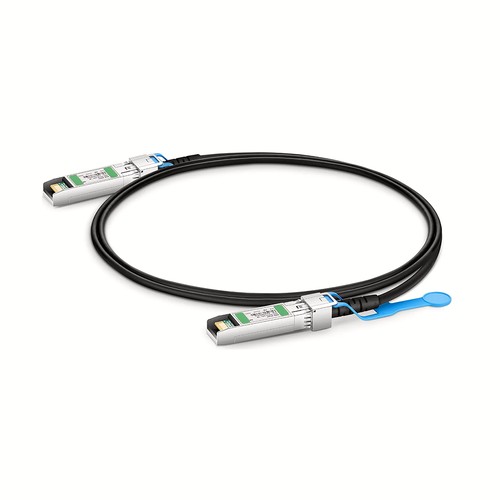
For equipment that specifies Generic Cable Series, this HT-manufactured ACC family offers 50G direct-attach connectivity with SFP56. Rather than treating different OEM length codes as interchangeable, the available configurations below link to their own product pages. Mechanical details, installation planning and factory checks are included for engineering and purchasing review.
Series Part Number: Cable SeriesHT Part Number: Cable Series
Product Highlights
- HT-manufactured compatible alternative for Generic Cable Series
- 50G aggregate connectivity at 50Gbps
- Interface configuration: SFP56
- Active Twinax
- Length configurations covered: 1m (3ft), 2m (7ft), 3m (10ft), 5m (16ft) and 7m (23ft)
- Conductor specification: 30AWG
- Power consumption: ≤0.5W
- Operating temperature: 0 to 70°C (32 to 158°F)
Available Lengths and Corresponding Part Numbers
The documented configurations are 1m (3ft), 2m (7ft), 3m (10ft), 5m (16ft) and 7m (23ft). Each link below opens the separate product page for that physical length and its corresponding OEM part number. Select the exact assembly required by the route and purchase order; custom project lengths can be discussed separately.
Compatible OEM Part Numbers
- Cable Series-1M3FT
- SFP56-50G-ACC-2M7FT
- SFP56-50G-ACC-3M10FT
- SFP56-50G-ACC-5M16FT
- SFP56-50G-ACC-7M23FT
- Cable Series
Specifications
| Compatible | Generic |
|---|---|
| Manufacturer | HT |
| HT Part Number | Cable Series |
| Form Factor | SFP56 |
| Max Data Rate | 50Gbps |
| Cable Type | Active Twinax |
| Max Cable Distance | Up to 7m |
| Cable Length Options Covered | 1m (3ft), 2m (7ft), 3m (10ft), 5m (16ft) and 7m (23ft) |
| Wire AWG | 30AWG |
| Power Consumption | ≤0.5W |
| Jacket Material | PVC |
| Storage Temperature | -40 to 85°C (-40 to 185°F) |
| Operating Temperature | 0 to 70°C (32 to 158°F) |
| Modulation Technology | PAM4 |
| Bit Rate | 53.125 Gbps |
| Protocol | SFP56 MSA |
Field Installation and Maintenance
Inspect the route and both connectors before installation, then support the cable without pulling on either connector housing. During maintenance, release the latch properly rather than using the cable as a handle. Keep protection on unused ends, and if the assembly is removed for later use, coil it loosely and record its part number so the same length can be returned to service. For this series, keep the interface rate, ACC construction and length-specific OEM reference together throughout that review.
Applications and Deployment
Active copper assemblies add signal conditioning while retaining the convenience of a direct-attached cable. They are appropriate where the equipment supports the stated active-cable type and the route exceeds the practical limits of a comparable passive assembly. Per-end power, airflow and host qualification should be assessed before high-density deployment. For this series, the listed interface is SFP56 and the aggregate rate is 50G.
Cable Construction and Routing
For this assembly, the conductor specification is 30AWG; the jacket material is PVC; the operating temperature is 0 to 70°C (32 to 158°F); the power consumption is ≤0.5W. These parameters belong in the installation review rather than being treated as catalogue trivia. Route the cable through its intended managers without tension, avoid pressure close to the connector boots and leave enough space to operate the latches. Any service loop must respect the stated bend limit.
Quality Assurance and Packaging
The cable and both connectors are inspected before a functional link test. Connector protection and bend-safe packing reduce handling damage during transport and storage. Customer or site labels can be added for field inventories, with different lengths separated to simplify issue and return of spare assemblies. Both connector ends are inspected as part of the complete assembly, and protective packing is selected to avoid tight bends during transport and storage.
Generic Compatibility and Factory Testing
A field-ready cable needs both correct identification and a stable operating link. Our pre-packing check therefore includes the connectors, host recognition and link behavior. For equipment with uncertain revision history, providing the host model and software release helps identify compatibility requirements before the assembly reaches the installation site. Series-level inspection is followed by the exact length and OEM configuration selected for dispatch. Functional verification includes link establishment and diagnostic indications where the host exposes them.
Ordering Information
Request the cable by its exact part number and length, and state the equipment model if compatibility confirmation is needed. Site orders can list quantities by rack or installation team. Any requested label should retain the part number so a removed or spare cable can still be identified accurately. For this series, follow the corresponding length link, quote that exact OEM part number and keep different lengths on separate order lines. HT part number Cable Series identifies the product family; the linked page provides the final length-specific identity.
Shipping and Lead Time
Standard configurations normally ship within one to three working days, with production lead times confirmed for larger quantities. International courier, air freight and sea freight are available; customer courier accounts and nominated forwarders are accepted.
Frequently Asked Questions
Is this an original Generic cable?
No. It is an HT-manufactured compatible cable for equipment that specifies Cable Series, not an original Generic-branded product.
Are different lengths and OEM part numbers separate products?
Yes. Where a length has its own OEM reference, follow the corresponding link above and order that exact part number on its own line. Do not substitute another length only because the connector arrangement is the same.
Does this ACC cable require separate modules at each end?
No. The connector ends and cable form one complete direct-attach assembly. The ends are not detachable standalone transceivers, and the complete product is tested together.
What information helps confirm compatibility?
Provide the equipment manufacturer and model, port type, hardware revision and software release, together with the required OEM reference, length and quantity. Breakout projects should also identify the intended lane configuration.


