400G OSFP 4x 100G PAM4 to QSFP-DD 8x 50G PAM4 AOC, 30m
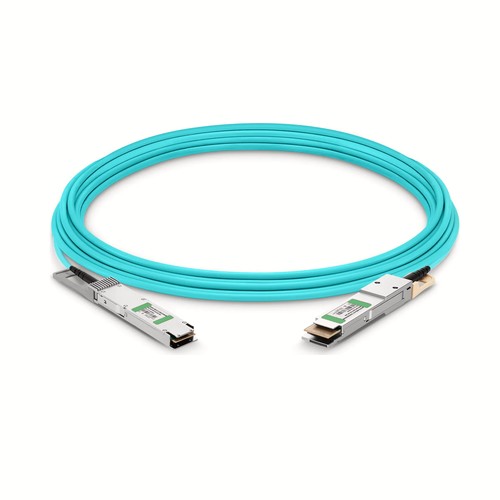
The 400G OSFP 4x 100G PAM4 to QSFP-DD 8x 50G PAM4 AOC, 30m connects OSFP (RHS/Flat Top) to QSFP-DD ports at 400Gbps over AOC fiber at 850nm. Because the optics are built into the cable ends, installation is plug and play with no separate transceivers to manage, and airflow inside the rack stays unobstructed. It is well suited to 400G Ethernet data centers, HPC and machine learning clusters. You can order standard lengths from 1m (3ft) to 30m (98ft).
Product Highlights
- OSFP (RHS/Flat Top) to QSFP-DD
- Data rate: 400Gbps
- Cable type: AOC
- Length: 10 options from 1m (3ft) to 30m (98ft) as standard
- Wavelength: 850nm
- DDM/DOM: Supported
Specifications
| Part Number | QDD56-400G-O112RAO30 |
|---|---|
| Manufacturer | HT |
| Form Factor | OSFP (RHS/Flat Top) to QSFP-DD |
| Max. Data Rate | 400Gbps |
| Cable Length | 1m (3ft), 2m (7ft), 3m (10ft), 5m (16ft), 7m (23ft), 10m (33ft), 15m (49ft), 20m (66ft), 25m (82ft), 30m (98ft) |
| Cable Type | AOC |
| Wavelength | 850nm |
| Minimum Bend Radius | 30mm |
| Transmitter Type | VCSEL |
| Receiver Type | PIN |
| Max. Power Consumption | 14W (OSFP End) 10W (QSFP-DD End) |
| Modulation Format | OSFP-4x 100G-PAM4 QSFP-DD-8x 50G-PAM4 |
| CDR (Clock and Data Recovery) | No |
| Jacket Material | OFNP |
| DDM/DOM | Supported |
| Commercial Temperature Range | 0 to 70°C (32 to 158°F) |
| Protocols | OSFP MSA, QSFP-DD MSA, CMIS 4.0, IEEE 802.3ck-400GAUI-4, IEEE 802.3bs-400GAUI-8 |
Applications
The 400G OSFP 4x 100G PAM4 to QSFP-DD 8x 50G PAM4 AOC, 30m connects OSFP (RHS/Flat Top) to QSFP-DD ports at 400Gbps in 400G Ethernet data centers, HPC and machine learning clusters. This unit is delivered in 10 standard lengths from 1m (3ft) to 30m (98ft). The integrated construction removes separate optics from the link budget and reduces the number of failure points in the row. Custom labeling, packaging and compatibility coding for specific equipment vendors are available from our factory on request. The link runs OSFP-4x 100G-PAM4 QSFP-DD-8x 50G-PAM4 modulation, which keeps it aligned with current 400G switch silicon.
Standards and Compatibility
This product is designed and tested to comply with OSFP MSA, QSFP-DD MSA, CMIS 4.0, IEEE 802.3ck-400GAUI-4, IEEE 802.3bs-400GAUI-8. It plugs into any standards-based OSFP (RHS/Flat Top) to QSFP-DD port, and compatibility coding for specific switch or router brands can be done in our factory before shipment.
Ordering Information
The ordering part number is QDD56-400G-O112RAO. We make this cable in 1m (3ft), 2m (7ft), 3m (10ft), 5m (16ft), 7m (23ft), 10m (33ft), 15m (49ft), 20m (66ft), 25m (82ft) and 30m (98ft). Special lengths outside this range can be produced to order. Volume pricing is available for project quantities.
Packaging
Each unit is sealed in an anti-static bag, cushioned in a blister tray and boxed in an export-grade carton. Outer cartons carry handling marks and can be palletized for air or sea freight. If your project requires retail boxes, barcodes or your own brand on the label, we can arrange that as well.
OEM and Custom Orders
We have manufactured fiber optic connectivity products since 1995 and run our own production lines in Shenzhen. Beyond the standard catalog we build to order: special cable lengths, custom connector combinations, vendor-specific compatibility coding and private labeling. Send us your requirement and our engineers will quote a practical solution.
Delivery
Goods are normally sent by courier such as DHL, UPS, FedEx, TNT or EMS; air and sea freight are also available on request. Commonly used items are kept in stock for immediate shipment, and out-of-stock items are usually delivered within a few working days. We can also ship on your courier account or hand goods to your appointed forwarder.
Quality Assurance
Before any product leaves our factory it goes through optical performance testing, compatibility verification on real switch platforms and a final visual inspection. Our in-house test lab holds a wide range of current and legacy switches from major brands, so interoperability is proven on the actual equipment your network uses rather than assumed from paper specifications.


